Posts

Showing posts with the label political science

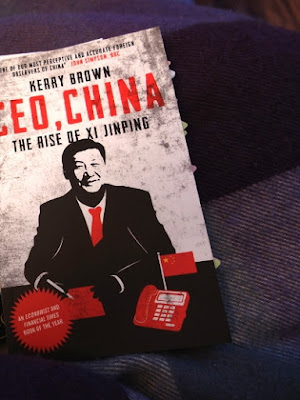
CEO, China: The Rise of Xi Jinping - Thoughts & Review, Part 3

Image
How does one become the President of China? If the electoral college seems at times hard to fathom, an election in the Chinese Communist Party (CCP) is even more esoteric.  According to Kerry Brown, author of CEO, China and former diplomat, the rise of Xi Jinping to the supreme leadership role in China "belonged more to the realm of magic than political science" (p. 92).  The process by which Xi replaced Hu Jintao (2003–2013) was unlike a democratic election, in part because it required a consensus amongst the Party: a one-party state cannot be seen as divided.  This image of unity is one which brought Xi to power and which continues to challenge him as he seeks to maintain that power. (Note: This is a multi-part review, though each part can be read on its own.  Please see Part I and Part II , if you'd like to read more.) U.S. Defense Secretary Robert M. Gates and Chinese Vice President Xi Jinping, 2011 - by Jerry Morrison Coincidence and Conviction Xi's life has ...

CEO, China: The Rise of Xi Jinping - Thoughts & Review, Part 2

Image
As president of China, Xi Jinping presides over 18% of the world's population, and he is set to do so for life.  How did Xi rise to such prominence, and what can we learn from his life that will help us understand his future?  Kerry Brown's book, CEO, China , offers some clues as to the man behind the mystery. (Note: This is a multi-part review, though each part can be read on its own.  You can read Part I here if you like.) George W. Bush and Xi Jinping, August 2008 - by Eric Draper The Young Xi: Two Sides of History "The issue of whether Xi is a 'Maoist' is a live one in China," writes Brown (p. 10).  As he goes on to illustrate, Xi's historical and cultural relationship to Mao is not only complicated but personal, with origins that go back to Xi's childhood and his father, Xi Zhongxun. Xi Zhongxun began his career as a distinguished communist soldier, fighting  both the Japanese and the Chinese Nationalists throughout the 1930s-1940s.  This was an ...

CEO, China: The Rise of Xi Jinping - Thoughts & Review, Part 1

Image
"What do you know about the man who runs China?" the blurb demanded. "Nothing," I blinked.  Well, basically nothing. I couldn't believe it...I knew basically nothing about Xi Jinping, one of the most powerful leaders in the world today.  (I also have some Chinese heritage, which makes it even more embarrassing.) Xi, in fact, may wield more influence than any other secular leader.  He functions not only as General Secretary of the Communist Party of China (CPC) but also as their "core leader" - putting him in the same league as Mao.  In parallel, he shows the other communist nations (nominally very few) what a strong communist leader looks like.  With a GDP on track to overtake the United States' in the next decade , China's version of socialism is not to be ignored, and Xi is well placed to be more than just a figurehead. Search Amazon for "xi jinping biography" and relatively few books come up.  Remove the word "biography...

The Prince - A Study in Expediency

Image
Therefore it is unnecessary for a prince to have all the good qualities I have enumerated, but it is very necessary to appear to have them. And I shall dare to say this also, that to have them and always to observe them is injurious, and that to appear to have them is useful; to appear merciful, faithful, humane, religious, upright, and to be so, but with a mind so framed that should you require not to be so, you may be able and know how to change to the opposite.  Through much of the first half of Niccolò Machiavelli's The Prince , I did not understand the reason so much malevolence is associated with the author's name.  The first seventeen chapters come across as a detailed guide or manual to being a successful ruler.  Machiavelli initially comes across as pretty fair-minded for his time; he gives examples of successful princes, discusses soldiering much in the vein of Sun Tzu (he would later write his own The Art of War ), and even...

Nightmarish Utopia

Image
I believe Sir Thomas More meant well when he penned Utopia (1516), but it is quite possibly the worst book I have ever read. Given the standard of living for the majority of human beings in the early 16th century, More's dream of a perfect nation must have sounded as idyllic as it gets.  Yet even so, 16th-century Europeans hardly lived sheltered lives.  By what reasoning, then, could More ever seriously imagine the existence of a Utopia, in either reality or fantasy?  In his world, all men have the will to be saints, and if not, then their angelic neighbors find the power to overcome all evils of society.  He speaks of shared gardens, and shared houses, and property that belongs to no one because it belongs to everyone.  He talks of quasi-elections and rulers for life, in the same breath.  Human nature, if it exists in Utopia, is easily kept in check by the noble ideals that all the citizens yearn for, as well as their continuous eagerness to work togethe...

Mackinder's Heartland Theory

Image
Who rules East Europe, commands the Heartland Who rules the Heartland, commands the World Island Who rules the World Island, commands the World Though they may be deemed outdated now, Sir Halford Mackinder 's Heartland Theory and his writings on geopolitics offer some fascinating--and still relevant--pieces of wisdom on the relations between geography, history, and foreign policy.  My poli-sci class inspired me to do some further reading, so I read "The Geographical Pivot of History" (1904) and its follow-up, Democratic Ideals and Reality (1919). The "Geographical Pivot" ( 5/5 stars ) is a succinct description of the Heartland Theory, while Democratic Ideals ( 4/5 stars ) is much slower and more intense, focusing heavily on Mackinder's historical basis for the theory.  Most of the history went over my head, but the gist of it--sea power vs. land power--provided a good argument for the eminently strategic location of Eastern Europe. It's debatable whethe...