Posts

Showing posts with the label 4 stars

Nostromo: The Lighthouse - And Final Thoughts

Image
Previously: Part I - The Silver of the Mine Part II - The Isabels The situation has reached a boiling point: General Montero's rebel forces have dismantled the government and are sweeping over Costaguana, while the traitor Sotillo, invading Sulaco by steamship, comes to establish a reign of terror.  The citizens flee to the countryside, seeking protection by the once-feared bandit Hernandez.  Everyone believes Nostromo and Martin to be dead, and Dr Monygham fears for the safety of Emilia Gould, who, half-abandoned by her workaholic husband, still remains in the town.  He realizes he must take action to save her, while the rebels and the elusive silver begin to take a corrupting hold over everybody else. There is much, much more that happens in this third part, but I can't give it away.  It's as well Part III takes up nearly half of the book, because the initially slow plot here picks up with gusto, taking all the world-building from the first two parts and ...

Fear No Evil: The Classic Memoir of One Man's Triumph Over a Police State

Image
Prime Minister Shimon Peres (left) welcomes released Prisoner of Zion Antatoly Sharansky as he steps off the Westwind plane arriving from Frankfurt at Ben-Gurion Airport. Government Press Office (Israel) [ CC BY-SA 3.0 ] For many of us the scientific-technological revolution arrived at precisely the right time, with the world of science as a kind of castle where you could protect yourself from the shifting winds of official ideology. (p. xii) This single sentence from Natan Sharansky's memoir Fear No Evil really grabbed me.  Here is someone I could immediately relate to in a unique way.  I'm not brilliant at chess, math, or computer science like Sharanksy, but I understand him.  In a world where politics and ideology are constantly in our face, some of us cling to science and technology - constants of logic and scientific process - as a way to feel safe and find commonality. But what happens when not even science can protect you?

The Code of the Woosters - A Novel for New Year's Resolutions

Image
Already feeling the post-holiday blues?  Sometimes you just need a good British comedy to help get you back into the festive spirit.  And for good British comedy, you simply can't go wrong with P. G. Wodehouse. The Code of the Woosters (1938) is book #7 in his Jeeves and Wooster series but, as with many of the adventures of this duo, it can be read on its own. The scene opens with Bertie Wooster, an idle man-about-town, shunning the opportunity of a Round-the-World cruise, against the counsel of his smarter but dutiful servant, Jeeves.  Wooster's boredom disappears when his beloved Aunt Dahlia shows up, demanding he steal a silver cow creamer from collector Sir Watkyn Bassett, who, she believes, wrongfully acquired what was rightfully her husband's.  The trouble is, Bassett is the same magistrate who Wooster had a run-in with before, not to mention the father of his dreaded sometime fiancee, Madeline Bassett.  Wooster's friends Gussie Fink-Nottle and Stiff...

"My Kinsman, Major Molineux"

Image
Portrait of James Thomas Fields (1817-1881), Nathaniel Hawthorne (1804-1864), and William Davis Ticknor (1810-1864). Over on Instagram , I'd mentioned I've been getting into Hawthorne's short stories again.  He's a favorite author of mine, and when I read the collection Twice Told Tales (already five years ago, wow!), I was blown away by the craft of his shorter works.  I finally broke down and bought the complete Tales and Sketches, and for my first reading chose "My Kinsman, Major Molineux," one of the more famous ones. The story is set up simply enough: a young man and clergyman's son, Robin, sets out one day to seek his fortune.  More specifically, he leaves the countryside and arrives in Boston in order to get in touch with Major Molineux, a relative who had once offered to help him get started in life. It's a dark, gloomy night in Boston.  Robin goes from door to door, inquiring for his kinsman.  Everyone laughs at him, while he wand...

Elie Wiesel's Open Heart, and Thoughts on Christian Suffering

Image
In his memoir Open Heart , Elie Wiesel takes us through his experiences surrounding his 2011 open heart surgery.  Wiesel is famous for his Night trilogy, and here some of the same themes come back in short, fleeting chapters - the dark memories of life in Auschwitz and Buchenwald, as well as the perennial question: why does God allow His children to suffer evil?  What should a Jewish person's response be in times of persecution or pain?  Question marks abound in this short work, underlining the great despair we may sometimes feel when evil touches our lives. One reason I picked up this book was to understand something of what a patient experiences during this medical procedure.  My grandma has faced a myriad of health issues, including two heart surgeries; she endured them with grace even while she was in terrible pain.  What could she have been feeling?  I have never asked her, choosing instead (as with other personal questions) to seek another avenue of ...

Peter Pan in Kensington Gardens

Image
Michael Llewelyn Davies as Peter Pan - Photo by J. M. Barrie Peter Pan - immortal, magical, and forever lonely - has his origins in a novella called Peter Pan in Kensington Gardens (1906).  This little story predates the more famous novel Peter and Wendy by some years (the latter I reviewed in my latest podcast episode " Getting Older with Peter Pan ").  Like his fictional contemporary Sherlock Holmes, Peter Pan was both a real-life figure and a figment of imagination, a character who would haunt his author for decades.  There are glimpses of this bittersweet legacy in Kensington Gardens , itself an excerpt of a larger novel, The Little White Bird .  Through this iterative story development, one easily senses J. M. Barrie 's personal connection to the Peter Pan mythos. The tale begins with an anonymous father-figure and a boy named David who take walks in London's famous Kensington Gardens.  The narrative drifts from a conversational discussion of the Gardens ...

February Reviews - Lightning Round!

Image
Tender Is the Night - F. Scott Fitzgerald - (no rating) Biggest disappointment of the year so far; did not finish. The Atlas of Beauty - Mihaela Noroc - 3 stars An interesting library book.  Somewhat repetitive; would've  preferred less social-political commentary. Embers - Sándor Márai - 4 stars Surprisingly great!  European history buffs will appreciate  this ruminating novel.  Full review here . Poetry of the First World War - ed. Marcus Clapham - 3 stars Not an easy or pretty read, but a sobering one.  More thoughts here . Moonflower - Jade Nicole Beals - 4 stars   Poems of peace and introspection; this was a refreshing read. Anthem - Ayn Rand - 2 stars Great concept, so-so execution.  Full review here . Breakfast at Tiffany's - Truman Capote - 1 star Writing style on point, story not my cuppa.  More thoughts here . This has not been the month for in-depth, written reviews, and I'm feeling a bit sheepish about that.  Work ha...

The Art of War, and other conflicts

Image
The Art of War would be better marketed today as "The Art of Problem Solving."  As far as warfare goes, you won't find anything here that has not been amply represented in documentaries, novels, movies, and current events.  I guess we are (morbidly) privileged in the 21st century to have seen Sun Tzu 's advice played out, as well as ignored, in countless brutal conflicts, so reading this as a guide to war brings nothing new to the modern, armchair reader.  Read as a metaphor for IT project management, however, this book still offers good guidance on how to be an effective leader and make optimal use of resources to solve problems.  Though discipline is emphasized, he also highlights the necessity of being flexible and using brains over sheer strength.  The time he spends on the psychology of the players, including the enemy and one's own forces, reminded me of T. E. Lawrence's tactics in the Middle East.  Information is critical to identifying victory, so ...

Returning to The Wonderful Wizard of Oz

Image
Currently: at home, listening to the rain, trying to fend off the beginnings of a cold.  (I haven't been sick in quite some time...it was bound to happen.) What better time to talk about The Wonderful Wizard of Oz ? Most people are familiar with the film, having the somewhat abbreviated title of The Wizard of Oz .  It was one of my childhood favorites, perhaps more so even than Mary Poppins , and I still love it.  You'd have to be hardhearted not to at least sympathize with Dorothy's plight and desire to find home, after a gigantic cyclone tears her family apart and literally drops her in a strange, fantastical land.  For my part, I've never stopped wanting a pair of ruby slippers (magical or otherwise). L. Frank Baum's 1900 book predates the film by some decades and the modern reader by over a century.  It takes us a little more imagination to picture even Kansas.  Baum's sparse yet concise prose helps us in this: When Dorothy stood in the doorway and lo...

Cloaked - Little Red Riding Hood in the Wild West

Image
(Not the real cover.)  You can check out the cover art and pre-order the book here ! Little Red Riding Hood meets classic Western - what a cool idea!  I was excited to read Cloaked , because I love LRRH, and fairy tales and Westerns are two of the best storytelling genres out there.  Since LRRH already has some Western elements (woods and wolves!), I was curious how the two would merge in this retelling. The story begins with Mary Rose O'Brien boarding a stagecoach to visit her grandmother.  Mary Rose is extremely nervous because she's never met her grandma Jubilee before, yet her parents are hoping that, by making a good impression, she will mend the long rift between Mary Rose's father and Jubilee.  To make matters worse, her traveling companions are a rough-looking laborer and an over-friendly bookkeeper, and she is not sure she can trust either of them.  Mary Rose is hoping for some adventures at her grandma's Wyoming ranch, but when she arrives, she ha...

The Cruise of the Snark - Jack London and his trip across the Pacific

Image
The Snark , named after Lewis Carroll's poem "The Hunting of the Snark" Jack London's squall-infused, sickness-filled, Snark-y voyage is a sailing classic and product of its time, for better and worse. Compare his tongue-in-cheek narrative with his very real sufferings, his sympathetic view of Molokai versus his feelings of white superiority, or his socialist convictions with his celebrity lifestyle, and you'll find a fully flawed, yet vivid memoir with plenty of takeaways. I would have liked to hear more about his small crew, which is why Penguin was smart to include some excerpts from Martin and Charmian in the back. Overall, an educational adventure into the South Pacific of the early twentieth century. Jack London and Charmian in Hawaii Jack London at the building of the Snark

The Begum's Millions

Image
One day, out of the blue, the unassuming Dr. Sarrasin learns he is heir to an enormous fortune.  It seems he is the only living descendant of a Frenchman who married a begum - "a Muslim lady of high rank" -  and, through her wealth, became rich.  As it would happen, another claimant to the fortune shows up, a German professor by the name of Schultze.  To avoid an expensive court case, they agree to split the money in half and each spend it on the projects of their dreams.  These projects turn out to be two new cities, both highly regulated but as different from each other as the masterminds who founded them.  Away in the wilds of Oregon state, the cities are built and populated, thriving till one man's sinister ideals threaten to undermine both topias.  This is quite a page-turner and, in spite of the Vernian themes, a somewhat different read than most other of his novels I've read. The exploration of dystopia vs. utopia in the Pacific Northwest ...

Reading England 2016 - Recap

Image
When I joined this challenge a year ago, I had every intention of branching out and reading books from multiple counties.  As it turns out, I stayed in familiar territory and read London for all three books (Level 1). The Mint was a fitting sequel to Seven Pillars of Wisdom .  For some reason I went into it expecting a novel, but it's actually a journal-like memoir of T. E. Lawrence's peacetime experiences in the military.  After his campaigns as "Lawrence of Arabia" - and, as importantly, after his attempts to deal with politicians - T.E. was sick of being a leader and wanted to disappear from the public eye.  He joined the service under an assumed name, and that is where he found a place of security and camaraderie, the R.A.F.  The Mint is a coarse novel, written in a modern voice (for the times) and full of all the profanities and vulgarity that Lawrence encountered around him.  I found myself unable to rate the book, because it came across as an hones...

Melville's "Mosses" - from an Old Mast

Image
The actual title of the book is Billy Budd and Other Stories , published by Penguin Classics.  However, there is such a similarity in the writing, I was reminded of the title of a Hawthorne collection, Mosses from an Old Manse .  Since Hawthorne was the dedicatee of Moby-Dick  and also referenced by name in one of these stories, I'm sure Herman Melville  would take the comparison as a compliment! Overall, I give the book 4 stars , but it's a mixed bag, so I'll review each story on its own: Bartleby, the Scrivener I really loved this story.  It's probably the closest thing to Kafkaesque,  pre -Kafka, that I've read.  Bartleby is an enigmatic scrivener (copier - think Nemo from Bleak House ), and it's hard to say if he's the hero or the antagonist, but he is certainly the mystery.  I'm still not sure what to make of it, but it's one of those stories that is very good at painting atmosphere and the impression of things. The Piazza Another kind of mys...

White Nights in October

Image
For my next read after Brothers K, I returned to White Nights and Other Stories , which includes several Dostoyevsky short stories translated by Garnett.  This collection was a mixed bag; in spite of that, I give it a cumulative  4 out of 5 stars based on enjoyment level. The first and feature story is White Nights , a very romantic, fanciful sketch about unrequited love.  Previously, I had read some quotes from it online, and reading the entirety, I was not disappointed.  The ending was so depressing, but the story itself was bittersweet and thought-provoking.  Recommended if you want to read Dostoyevsky in a nutshell. I skipped Notes from Underground , having already read it. A Faint Heart was a psychological mystery, reminiscent of Melville's "Bartleby, the Scrivener" which I read in September.  (Not to sound like a broken record, but it is worth mentioning that Dostoyevsky's so-called "existentialist" themes are sometimes compared to Kafka, as was ...

Hamlet Revisited

Image
Over time, I have come to love a lot of things I used to dislike strongly - opera, Debussy, Moby-Dick , and poetry.  Perhaps Shakespeare will grow on me, too - perhaps. As I was reading Hamlet yesterday, I was aware of two things.  One, it was not painfully slow or cringeworthy like Romeo and Juliet .  Two, I actually cared about the characters. As long as they were "on screen," they were very much alive (terrible, terrible pun), and even now, I would be interesting in watching an adaptation, which usually indicates a good story. The plot starts out with some exposition explaining that the king of Denmark has recently died and his brother Claudius is serving the office in his stead.  Part of this "office," according to Claudius, is marrying his brother's wife, Queen Gertrude.  (Wiki would have you think this is a Levirate marriage ; however, since Hamlet is the son of Gertrude and the late king, this does not appear to qualify as such, by Old Testament standards...

The Old Man and the Sea ~ Read-Along

Image
I was so excited to hear about this read-along at Hamlette's blog !  In fact, I got a bit of a head start and made sure to read it this past Saturday.  But that gives me time now to read other people's posts over the course of this week, and I'm looking forward to hearing other people's thoughts.  :) +  Have you read The Old Man and the Sea before?  If so, did you like it more or less after this reading than you did before? This was my first time reading the book, but I grew up on the classic film with Spencer Tracy. As a child, I absolutely loved Age of Sail books and movies.  What I especially liked about TOMATS was the Marlin jump.  It never failed to strike a bit of terror in me - I was right there with the Old Man, thrilled and awestruck by the size of the "Fish." This made the Marlin in the book sort of anticlimactic.  It was beautifully written and probably would have been exciting had I not seen the film - but it felt short, very short. ...

Stark Munro, 13 Days, and Master of the World

Image
The Master of the World Jules Verne 4 out of 5 stars A sequel to Robur the Conqueror , this 1904 Verne novel is centered on one of his classic themes: a vulnerable public terrorized by unknown and indisputably more powerful technology.  Here, U.S. lawman John Strock is sent to investigate "the Great Eyrie," in what becomes a sort of Americanized version of 20,000 Leagues .  Though it is hardly one of Verne's best, The Master of the World takes you into Verne's world with very little cumbersome prose, and I found it to be a rather fun read (and the Niagara Falls scene was truly exciting!). The Stark Munro Letters Sir Arthur Conan Doyle 4 out of 5 stars This interesting, often humorous series of letters can be best read as a fictional Doyle memoir, based on some real events in his early medical career.  For the medical side, read Round the Red Lamp - for the personal side, read this book.  Doyle fans will like it, as will anybody researching late Victorian life....

Two short reviews

Image
In the past, I have written these in groups of four, but today I only have two books to review.  They each get 4 out of 5 stars , so perhaps there is still uniformity to this, after all?  To Kill a Mockingbird Harper Lee It would seem I should have more to say about this book, but what can I say?  You probably know the entire synopsis with or without having read it before.  I enjoyed it, more than I expected.  The writing was more vivid than the plot, painting a complex examination of prejudice and tension that even the (excellent) movie could not evoke.  Atticus and Scout were deep characters.  The ending felt somehow disappointing after the intricate buildup, hence four stars.  But the journey, rather than the end, certainly makes it a worthy classic, so if you have procrastinated as I did, procrastinate no longer. Notes on Life and Letters Joseph Conrad I was reading this book for the longest time, I don't remember when I started it...

Meditations with Marcus Aurelius

Image
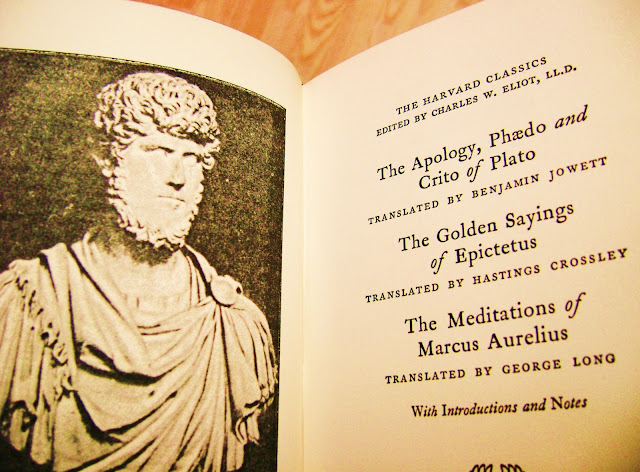
Such as are thy habitual thoughts, such also will be the character of thy mind; for the soul is dyed by the thoughts. One of my methods of minimizing bias in my readings and reviews is to avoid introductions.  For Meditations (tr. by George Long), I made an exception since the biographical note was at the beginning and only a page long.  Naturally, learning that Marcus Aurelius (r. 161–180) persecuted Christians during his reign over Rome was something that inevitably altered my perspective.  (If anything, it turned out for the best, giving me a better understanding of and context for the book.) Stoic philosophy has long interested me with its emphasis on mind and attitude vs. emotions and circumstances.  As I understand it, the overwhelming intent of Stoicism is the achievement of spiritual peace in the midst of physical/external turmoil, becoming mentally "uncontaminated by pleasure, unharmed by any pain, untouched by any insult, feeling no wrong . . . accepting ...