Posts

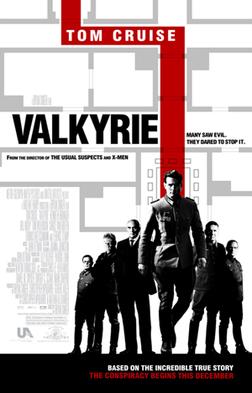
Valkyrie (2008) and My Thoughts on Historical Dramas
Image
This past weekend, I rewatched the WWII movie Valkyrie (2008) with my brother.  (He, like me, is a history nerd and was the one who talked me into watching Lawrence of Arabia , for which I'm perpetually grateful.)  I don't believe I reviewed Valkyrie last time, so it seemed like a good time to talk about it and about history-themed movies in general. Tom Cruise plays Colonel Claus von Stauffenberg, a Nazi officer, family man, and Catholic, who is tormented by his conscience and the events of the war.  In 1943, he joins a number of collaborators planning a political-military coup, which ultimately involves a plan to assassinate Hitler.  The genius of the plot is that it uses Hitler's own backup plan, "Operation Valkyrie," against him by feigning an emergency.  The movie zooms in on July 20, 1944, when Stauffenberg and his fellow officers attempt to carry out the assassination and coup. The first thing to get out of the way is the casting.  Now, don't...

A Vindication of the Rights of Woman - Week #4 / Wrap-Up

Image
We made it!  If you know me from past years, you know I'm terrible at sticking to read-alongs and challenges.  So I have to pat myself on the back for finishing this one.  :) Overall?  I give the Read-Along 5 stars - the pacing and discussion questions have been excellent.  The book itself, I give a solid 3 stars.  Wollstonecraft packed a lot of thoughts into the book, and I agreed with her on many points.  At the same time, there was a lot of needless repetition, which, if I hadn't been on a schedule, might have bogged me down completely.  On to the discussion questions: Do you agree or disagree with Wollstonecraft's arguments about "stupid" romance novels, in which an author presents perfect images of men and women in love and marriage. (We could even apply this to romantic films.) I couldn't tell exactly what kind of novels she dislikes, though it seems to be all of them?? Anyways, I would agree that romantic novels/films can b...

Top Ten Favorite Reviews

Cleo's twist on today's Top Ten Tuesday is right up my alley.  I've been reviewing books for a while now, and sometimes it's nice to reflect on what I've written about books in the past. Here's ten of my favorite book reviews, some old and some newer (for simplicity's sake, not including podcast episodes or movie reviews, only written book reviews): 1.  Heart of Darkness by Joseph Conrad - This is long overdue for another reading (plus a reading of Chinua Achebe's criticism of the book).  That said, I still like my theory about Kurtz being Marlowe's alter-ego! 2. Amerika by Franz Kafka - Kafka is tricky to review; in spite of that, I think here I hit upon all the important points. 3. The Sorrows of Young Werther by Goethe - Should I apologize for this??? I took WAY too much delight in this scathing review of a book by Goethe (of all people).  I don't often write negative reviews, but when I do... whew! 4. Magellania by Jules ...

A Vindication of the Rights of Woman - Week #3

Image
Week 3 of the Readalong covers chapters 6–11 which deal with early childhood, concepts of modesty vs humility, a woman's reputation, class differences, and parent-child relationships.  Whew!  In all seriousness, though, while I personally would have chosen a narrower scope for such a book, I admire Mary's willingness to take on a broad range of subjects and deal with each one in some detail. I think my biggest takeaway from the book thus far is how much it puts into context Jane Austen's work (and, no doubt, her contemporaries').  After an Austen phase in my tweens, I later became disenchanted with her stories, finding (frankly) not much in them which seemed relevant to my life.  However, if I had any doubt before what "sensibility" means or whether Anne Elliot's odious relatives were true to life, those doubts have been dispelled by reading Vindication . In fact, for the first time, I earnestly want to re-read Jane Austen, because everything makes se...

Kreisler's "Syncopation" (1925) - A Classical Cousin

Image
Recently, I dreamed I was playing the second movement of Tchaikovsky's violin concerto, on stage, in front of a professional violinist, whom I was trying to "prove myself" to (!!).  I did tolerably well, which is the surprising thing, considering I never learned the piece (though always wanted to). My violin Ever since then, I keep thinking about picking it up again. I've barely touched my violin since I quit taking lessons about ten years ago (can it be, already?), when college took over my time and energies.  I generally don't put much stock into dreams, but if nothing else, I feel inspired to start again, in seriousness. Some of my favorite music for the violin was written by Austrian composer Fritz Kreisler.  He's best known for his soulful "Praeludium and Allegro" (a piece I learned once) - in style, a kind of 20th-century successor of Vivaldi.  More delightful to me, however, are his lighter pieces in the turn-of-the-century style, or...

Thoughts on Revelation

Image
Just finished re-reading The Book of Revelation this morning.  This is one book I may never be able to analyze or understand satisfactorily; much of it still confuses me.  Still, I wanted to share some memories, literary references, and thoughts about Revelation , since it may be some time before I read it again. First, a note on the edition.  For this re-reading of the Bible, I've chosen the New King James translation in single-column format .  I grew up with the NIV and KJV, and I was curious about the NKJV.  Compared to the KJV, I've noticed not many, but some, differences.  Translation is a topic on its own; so far, though, I can say I've had a good experience reading this one. Flashback #1 - "Revelations" I don't know why, but since childhood, I thought the book was called Revelations , plural.  It appears this is a common misconception, according to Wikipedia.  Other titles mentioned on Wikipedia are: The Revelation to John The...

A Vindication of the Rights of Woman - Week #2

Image
Week 2 of the Readalong spans chapters 4 & 5 on the topics "the state of degredation to which woman is reduced" and "writers who have rendered women objects of pity, bordering on contempt." It looks like I highlighted more quotes in these chapters than in all of the first part. I was especially impressed by chapter 5, where Wollstonecraft responds to opposing views, including those of Jean-Jacques Rousseau.  Boy, she cuts him down to size (and reading what he wrote, I don't blame her).  I'm not sure I can put together a coherent summary of this section, so instead I'll go straight to Ruth's discussion questions (warning, LENGTHY post ahead!!):